How Can Companies Build an Effective Employee Productivity Measurement Strategy?

How can a company know whether its employees are genuinely productive rather than simply busy? Employee Productivity Measurement is the process of evaluating how effectively employees use their time, skills, resources, and effort to achieve defined business objectives. A strong measurement strategy looks beyond hours worked or the number of tasks completed. It considers the quality of work, efficiency, outcomes, collaboration, deadlines, and progress toward goals. For businesses, effective productivity measurement can help identify performance gaps, recognize high performers, improve workflows, allocate resources, and make better management decisions. The most useful approach combines quantitative metrics with qualitative insights instead of relying on a single productivity score.
Why Is Productivity Measurement Important?
Employee Productivity Measurement data gives organizations a clearer understanding of how work gets done. Without measurable indicators, managers may have to rely heavily on assumptions or subjective observations. A well-designed approach can help companies:
- Identify workflow bottlenecks and unnecessary processes
- Understand how employees spend working hours
- Recognize strong performance and improvement opportunities
- Set realistic and measurable goals
- Improve resource allocation
- Detect workload imbalances
- Support performance reviews with objective information
- Improve employee and team efficiency
However, measurement should support employees rather than create unnecessary pressure. The goal is to understand performance and improve working conditions, not simply monitor every action.
Which Metrics Should Companies Measure?
Choosing the right metrics is one of the most important parts of a productivity strategy. The metrics should reflect the employee's role and the organization's objectives.
Task Completion
Task completion measures whether employees finish assigned work within expected timelines. It can be useful for project-based roles, provided that quality is considered alongside quantity.
Quality of Work
A high number of completed tasks does not necessarily indicate strong productivity. Error rates, customer satisfaction, rework, and accuracy can provide a more meaningful view of performance.
Time Efficiency
Companies can examine how efficiently employees use available working time. This may include project hours, time spent on specific activities, or the time required to complete recurring tasks.
Goal Achievement
Individual and team objectives provide context for productivity data. Measuring progress against clearly defined goals helps organizations focus on outcomes rather than activity alone.
Collaboration
For modern teams, productivity often depends on communication and cooperation. Meeting participation, project coordination, response times, and successful handoffs can provide useful indicators when interpreted carefully.
How Can Companies Use a Performance Tracker for Employees?
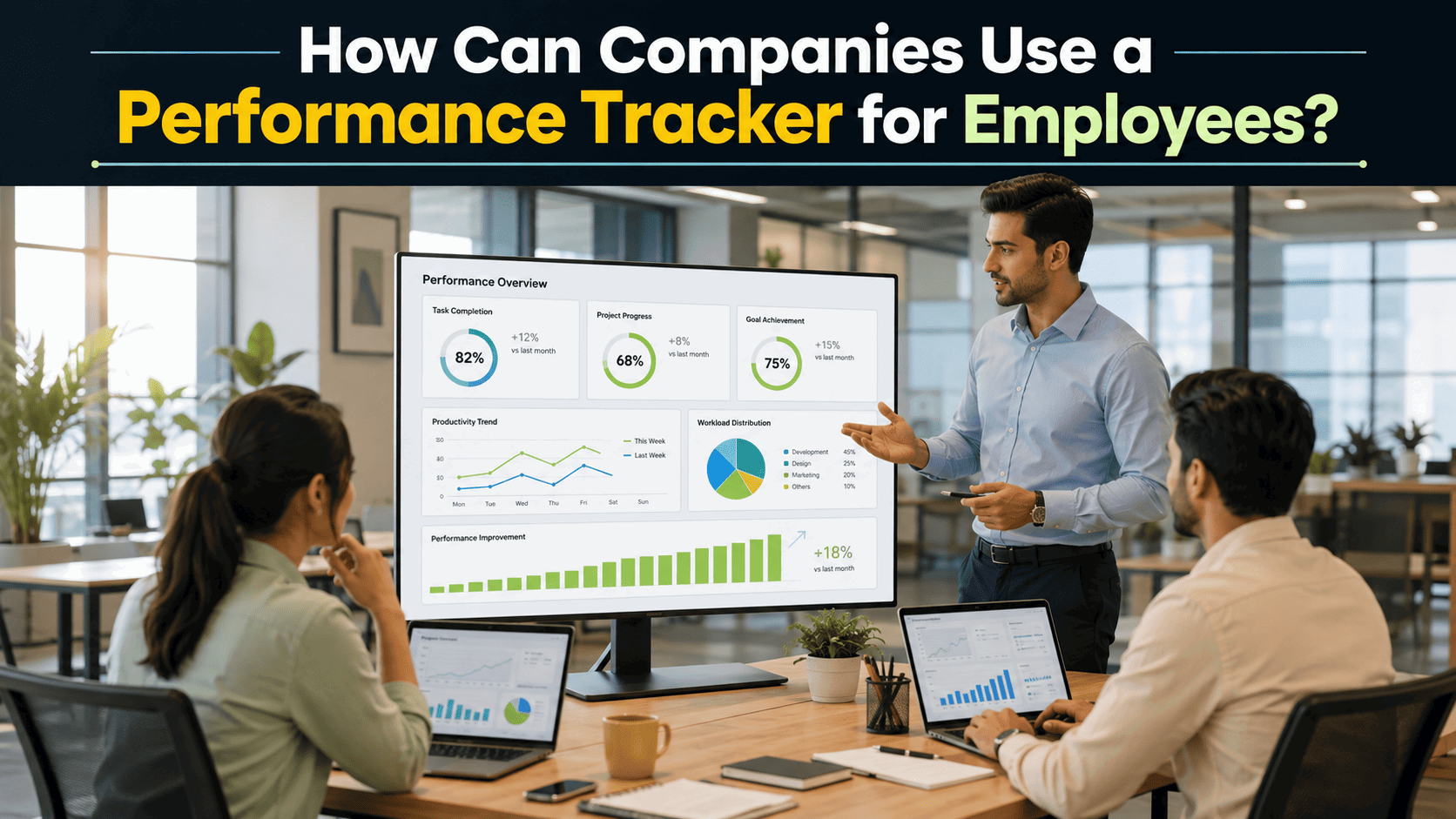
A performance tracker for employees can centralize relevant productivity information and make performance trends easier to understand. Instead of reviewing scattered reports, managers can use a structured system to monitor goals, completed work, project progress, and other role-specific indicators. The tool should be configured around meaningful outcomes rather than excessive surveillance. For example, managers might track:
- Progress toward assigned objectives
- Project completion rates
- Quality or error indicators
- Time spent on major projects
- Attendance and schedule adherence where relevant
- Team or departmental milestones
Employees should also understand what is being measured and why. Transparency helps build trust and gives workers an opportunity to use performance information for their own development.
How Can Companies Build an Effective Employee Productivity Measurement Strategy?
Building an effective strategy requires more than selecting a monitoring tool. Companies should establish a clear framework that connects employee activity with organizational outcomes.
1. Define Clear Objectives
Start by determining what the organization wants to improve. Objectives could include faster project delivery, improved customer service, fewer errors, better resource utilization, or stronger team collaboration.
2. Select Role-Specific Metrics
Different jobs require different productivity indicators. A salesperson, software developer, customer support representative, and creative professional should not necessarily be evaluated using the same measurements.
3. Combine Multiple Data Points
Avoid judging productivity through one metric. Combining quality, efficiency, goal achievement, and workload information provides a more balanced perspective.
4. Establish Realistic Benchmarks
Use historical performance, role expectations, project requirements, and team objectives to establish reasonable benchmarks. Targets should encourage improvement without becoming unrealistic quotas.
5. Review Trends Regularly
Productivity is not static. Managers should examine patterns over time rather than reacting to isolated changes. A temporary decline may result from training, a complex project, or changing priorities.
6. Turn Insights Into Action
Measurement only becomes valuable when organizations act on what they learn. If data reveals recurring delays, managers should investigate the underlying cause and improve processes, training, staffing, or workload distribution.
What Role Does Teams Task Management Play?

Teams Task Management can help organizations organize responsibilities, deadlines, priorities, and project progress in collaborative work environments. When task information is connected to broader productivity goals, managers can better understand whether teams are progressing toward expected outcomes. Task management should not become a simple count of completed assignments. A complex task may require significantly more effort than several routine tasks. Managers should therefore consider task difficulty, deadlines, quality, dependencies, and business impact. Combining task management with performance discussions can also help employees identify obstacles and prioritize important work.
How Can Companies Measure Productivity Without Micromanaging?
Effective measurement should create visibility without undermining trust. Organizations can achieve this by following several principles:
- Focus on outcomes instead of constant activity monitoring.
- Explain what data is collected and how it is used.
- Avoid treating every metric as a performance judgment.
- Give employees access to relevant performance information.
- Use data to identify support and training needs.
- Protect employee privacy and sensitive information.
- Review metrics regularly to ensure they remain relevant.
This approach makes productivity measurement a management and improvement tool rather than a surveillance mechanism.
How Should Managers Use Productivity Data?
Managers should use productivity information to ask better questions rather than immediately make judgments. For example, if an employee's output decreases, managers can investigate whether the cause is excessive workload, unclear priorities, technical problems, insufficient training, or changing project requirements. Similarly, consistently strong performance may reveal processes or working practices that could be adopted across the wider team. The purpose of measurement is therefore not simply to rank employees. It is to create actionable insight that improves individual performance, team coordination, and organizational efficiency.
You can also watch this video: Emp Monitor | Boost Workplace Productivity with Employee Monitoring Software

Summary
Effective Employee Productivity Measurement depends on measuring meaningful outcomes rather than simply counting hours or activities. Companies should establish clear objectives, select role-specific metrics, combine quantitative and qualitative information, and review trends over time. The best strategy also emphasizes transparency, employee privacy, and continuous improvement. When productivity data is used to identify obstacles, improve workflows, recognize achievements, and support employees, measurement can become a powerful tool for sustainable business growth.
Frequently Asked Questions
What is the best way to measure employee productivity?
The best approach combines task completion, quality, efficiency, goal achievement, and role-specific performance indicators rather than relying on one metric.
Should employee productivity be measured by hours worked?
Not necessarily. Hours worked show time investment, but they do not always indicate the value, quality, or effectiveness of the work completed.
How often should productivity be reviewed?
Managers can monitor relevant data continuously but should conduct meaningful performance reviews regularly, such as monthly or quarterly, depending on the role and business needs.
Can productivity measurement improve employee performance?
Yes. When used transparently, productivity data can reveal bottlenecks, clarify expectations, identify training needs, and help employees improve their workflows.
What should companies avoid when measuring productivity?
Companies should avoid excessive surveillance, unrealistic targets, one-dimensional metrics, and using isolated data points to make major performance decisions.
